PM Basics
What is the PM role?
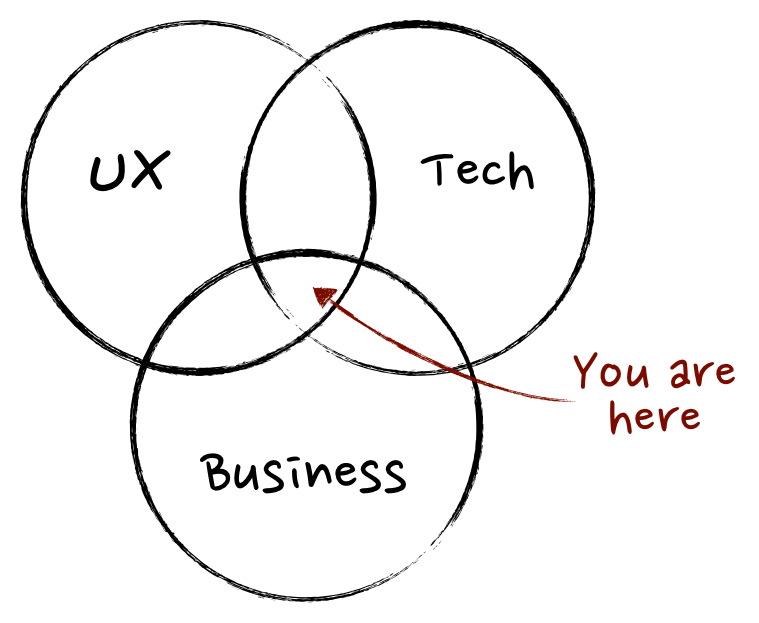
Product management is the intersection between business, technology, and user experience. A good product manager must be experienced in at least one, passionate about all three, and conversant with practitioners in all.
Why is the PM role required?
Different units in an org perform different functions and move towards achieving their goals. For example: Sales team is focused on achieving Sales target (Revenue), Finance team is responsible for the financial health and financial reporting of the company etc.
A Product manager on the other hand acts as the Voice of the customer. He/She needs to achieve business goals while being Customer obsessed thereby helping improve the product overall.
What does the PM do?
A product manager is broadly responsible for the following:
- Understanding customer pain points
- Could be existing customers or potential customers
- Needs of customers could be: Stated, Real, Unstated, Delight, Secret
- Setting the product vision
- Prioritising
- Roadmapping
- Aligning stakeholders
- Detailing the specs
- Execution of product/feature
- Measuring the performance
- Iterate
Agile development
- Agile project management is an iterative approach to managing software development projects that focuses on continuous releases and incorporating customer feedback with every iteration.
- Scrum is a framework for agile project management that uses fixed-length iterations of work, called sprints. There are four ceremonies that bring structure to each sprint.
- It all starts with the backlog, or body of work that needs to be done. In scrum, there are two backlogs: one is the product backlog which is a prioritised list of features, and the other is the sprint backlog which is filled by taking issues from the top of the product backlog until the capacity for the next sprint is reached.
- The 4 ceremonies in Scrum are: Sprint planning, Sprint demo, Daily standup, Retrospective.
Tools required
- Balsamiq / Figma — Wire framing and basic designing
- Lucid Chart / XMind etc — Mind mapping
- Notion — All Documentations
- JIRA — Organising sprints and monitoring progress
- Metabase — Generating quantitative insights
- Advanced Excel / G-Sheet — for Analysis
- Postman — to Demo and for testing APIs
- Dovetail for user research
- Hotjar for user interaction recordings
Points to Note
To get a full understanding of the Business/Product:
- Talk to as many internal stakeholders as you can
- Understand the business model
- Understand the history
- Understand how different people are influenced
- Understand how decisions are made.
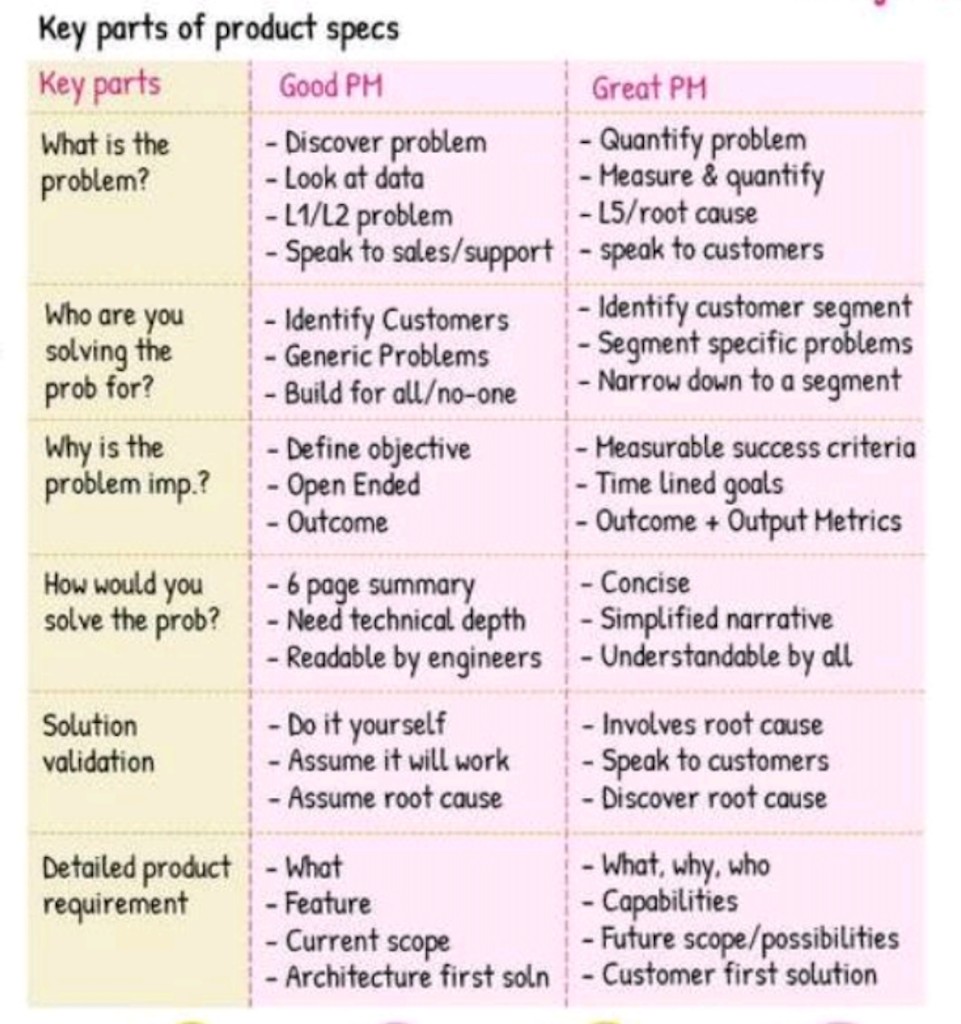
What differentiates a good PM from a great PM?
Credits: The Product folks